

MORE THAN WHAT REMAINS
Measuring the $141.8 Billion in ESOP Wealth Distributed to Workers
DOWNLOAD YOUR COPY
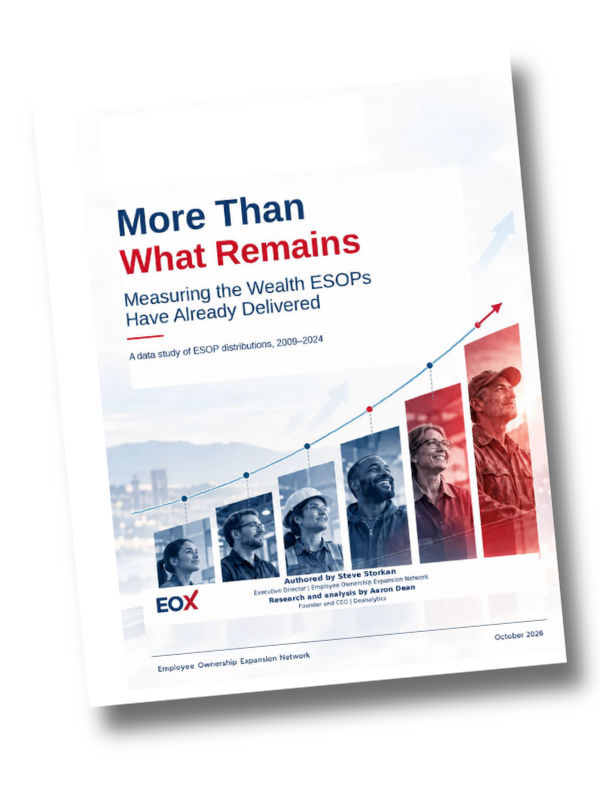
More Than What Remains: Measuring the Wealth ESOPs Have Already Delivered
National analysis introduces cumulative distributions as a new way to measure the economic impact of employee ownership.
$141.8 Billion in ESOP Wealth has already reached workers.
From 2009 through 2024, the ESOPs examined in this national study reported $141.8 billion in distributions to participants and beneficiaries.
Much of that wealth is missing from the way we usually describe the impact of employee ownership.
Not because it disappeared.
Because it already left the plans and reached people.
This Study examines sixteen years of federal Form 5500 data to measure a part of the ESOP story that has rarely been tracked over time: how much ownership wealth has already been distributed to workers.
WE DON'T GATEKEEP
We believe everyone, everywhere deserves to know about the transformative power of employee ownership.
Tell us where to email your copy of the complete study.
'26 ESOP Data Study - More Than What Remains
THE NUMBERS WE HAVE BEEN MISSING
We know how many ESOPs exist.
We know how many workers participate in them.
We know how much value remains inside ESOP plans today.
But those numbers leave something out.
When an employee retires, changes jobs, receives a distribution after a company sale, or otherwise receives the value accumulated through an ESOP, those dollars leave the plan. Future asset totals no longer capture them.
Using federal Form 5500 filings from 2009 through 2024, Steve Storkan of the Employee Ownership Expansion Network and Aaron Dean of Deanalytics examined cumulative distributions alongside employer contributions, new ESOP formations, plans entering termination, and current plan assets.
The result adds an important dimension to how we understand the economic impact of employee ownership.
$141.8B
Distributed to participants and beneficiaries from 2009–2024
$14.93B
Distributed in 2024 alone — the highest year in the study
$198.0B
Still held in net ESOP assets at year-end 2024 by the plans analyzed
$28.74B
Distributed by ESOPs that entered the termination process
"For years we have talked about how much wealth exists inside ESOPs, but we have done a poor job of celebrating the wealth that has already reached employees. This research gives us a powerful new way to tell that story. More importantly, it gives business owners, policy makers, community leaders, and employee ownership advocates evidence they can use to help create far more employee-owned companies."
- Steve Storkan
Executive Director | EOX
Storkan is an Executive Fellow at the Rutgers School of Management and Labor Relations (SMLR) Institute for the Study of Employee Ownership and Profit Sharing
A WELL-ROUNDED ACCOUNT OF
EMPLOYEE OWNERSHIP
These numbers are significant. They also reveal a broader view.
Wealth does not stop counting when it leaves the plan.
Cumulative distributions capture value that traditional year-end asset totals cannot. The study argues that this measure belongs alongside plans, participants and current assets when the field describes ESOP impact.
The end of an ESOP is not automatically the end of its value to workers.
Roughly one dollar of every five distributed during the study period came from ESOPs in the termination process. Some of those plans ended following company sales that produced substantial payouts for employee-owners.
This report examines those outcomes without treating every termination as either a success or a failure.
The national story becomes much more tangible at the state level.
The report includes state-by-state data on distributions, employer contributions, new ESOP formations, and plans entering termination.
That gives business owners, policymakers, economic developers, and State Centers something they have not routinely had before:
a way to see the wealth associated with employee-owned companies in their own states over time.
WHAT YOU'LL FIND IN THE REPORT
- Sixteen years of national ESOP distribution data
- State-level distribution and plan activity tables
- Analysis of new ESOP formation and termination activity
- Case studies showing what can happen when an employee-owned company is sold
- A closer look at wealth distributed by terminating ESOPs
- Implications for research, public policy, business-owner outreach and the EO field
- Questions the data cannot yet answer — and where the research should go next
THE POINT IS NOT JUST TO
COUNT THE WEALTH
It is to
create more of it.
Every year, business owners decide what happens next to companies they may have spent decades building.
Employee ownership will not fit every business. But far more owners — and far more of the professionals advising them — should understand what it has already produced for workers.
$141.8 billion gives us a powerful new piece of that story.
DOWNLOAD
YOUR COPY
and see for yourself how these numbers speak to the power of employee ownership.
LEARN MORE
Our 2025-2028 Strategic Plan lays out how we will further our mission in the coming years.
CONTRIBUTE
Whether you are a service provider that aids businesses in EO conversions, a like-minded organization who's mission is to help local communities, or a generous donor interested in funding our work, we all have a role to play in empowering hardworking Americans through employee ownership.
OUR MISSION
EOX expands employee ownership across the United States via a network of State Centers for employee ownership and national partnerships to increase community wealth, strengthen businesses and create a more vibrant, participatory economy.
We achieve our mission by:
- developing, convening, uniting, and supporting a network of State Centers
- engaging and collaborating with national entities and business owners to champion employee ownership
- amplifying the work of the State Center Network to increase education, awareness, and consideration of all forms of employee ownership